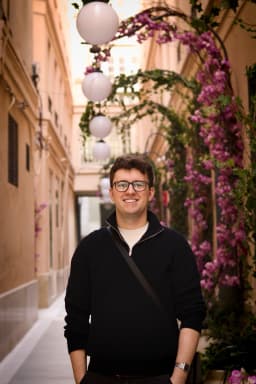
Reflecting on my first two semesters and courses taken after moving from FI to KISK at Masaryk University.
12 min readBranislav Mateas
Copy post as Markdown
On this page
"Today after this disaster season, I want to tell you that the good days are coming."
— Ruben Amorim (also me, convincing my parents the switch to KISK would work out)
If there was a motto for this semester, it would be this one. We'll ignore the fact that Amorim was sacked a few months later - hopefully my good season lasts at least until my bachelor's. From an average grade of 3.0 across my previous semesters at FI to a final average of 1.42 this semester, with the worst mark being a C from Information Ethics.
A clean slate, a new beginning, a fresh community,…
The transfer to KISK wasn't just a change of faculty. It was genuinely a reset. No egoistic feeling of "oh yeah, I already know this" attitude that FI sometimes brought out in me. Obviously, having IT background helps A LOT. It is also cool on the other end - I get to learn not only about technology, but come cool people, such as Claude Shannon, Jim Gray and others.
Having mostly needed the mandatory attendance anyway, the "Friday party" for KISK lectures was really nice. At the end of the day, one can make friends - it's like high school in a way, meeting around twelve times throughout the semester together. Which is nice.
Update May 2026: Revisiting this article, this got way harder for me this semester as the attendance became “less mandatory” let's say.
Still, being finally able to utilize my strong suit of listening in lectures drastically helped during the exam period. The social aspect was even amplified by community things like KISKforums.
Not to mention that I finished my exams before February - for like the first time ever. Pretty nice, I have to say. And even though my prior plans of visiting Japan weren't fulfilled in the end, I enjoyed the time to rest. I bingewatched almost all of the Ghibli films in the meantime, went skiing, went out with the dog, etc. It's nice to not be on the verge of being kicked out by test scores - or did I just get used to it?
In the meantime, I went crazy. I came up with an idea to take state exams from Informatics a semester prior to the KISK ones - because, why not?
Slowly but surely, I should also start thinking about my KISK bachelor thesis. Maybe a thesis in visualisations or metadata?
Update May 2026: It looks like I am gonna be writing about “Dark patterns” in cookie consent banners and their impact on users’ informed decision-making in the context of European legislation. I mean, at the end of the day, I am a digital analyst after all, even though I am a bit scared about the whole UX research.
One little thing I found weird comparing FI and FF: at FF the exam dates were released fairly late. I heard they are supposed to be released a maximum of two weeks before the exam period, which for some wasn't the case. Otherwise not really a problem.
Courses reflection
FF:AI001 - Elements of AI · Z
Async course - grinded through the first weeks to free up exam period. With an IT background it wasn't difficult, but the University of Helsinki course expanded my perspective further. Good fundamentals do that.
FF:ENTRE01 - Introduction to Entrepreneurship · Z
Practical assignments directly reflecting my current freelancing reality. Some of the takes were wilder than others, but the course completely exceeded expectations. Interesting people, useful perspectives, and a few ideas I'm still thinking about. Will maybe even write an article about some.
FF:ISKB60 - Prolegomena to Information Studies · P
A weekend away getting to know classmates and professors, for 4 credits. What more can I say.
FF:ISKB06 - Methodology of Information Studies and Librarianship · B
I didn't attend a single in-person lecture - but I watched every one before Christmas, at home, on a data projector. That counts for something. Also this is a course for students a year older than me.
What this course gave me was a way to think about statistics without formulas. I'm not suddenly a statistician. But I understand better when statistical thinking applies, what a hypothesis actually is, and how to reason about uncertainty. And that has direct consequences for my work.
So what: I realised I've been making analytical judgements without the vocabulary or structure to defend them properly. ISKB06 gave me that structure.
Now what: Work more with hypothesis-driven thinking in my analytics practice - formulate clear assumptions before diving into the data, test them explicitly, communicate uncertainty to clients rather than hiding it.
FF:ISKB02 - Introduction to Librarianship · B
Mr. Krčál lives for libraries. That's contagious. History, processes, legislation - as someone not from this field, it was a great introduction to a world I'd never really looked at. One marginal dream unlocked: having my own small library someday. Why not.
Also do you know he has a LinkedIn account? Fairly cool if you ask me.
FF:ISKB08 - Literature in Cultural Context · B
Getting up at 8:00 AM on the other side of Brno was rough. But Mr. Kudrnáč is a genuine authority on the subject, and the seminar paper on women's literature pushed me further than expected - both practically for future studies and in filling gaps in the Czech literary canon I didn't realise I had as a Slovak. I now have Goodreads. Progress. Our final output can be find here.
FF:ISKB17 - Information Ethics · C
I love discussing philosophical dilemmas - and the format here was perfect: two or three theoretical lectures followed by essays on specific problems, which we then worked through together in seminars. CMAP is a terrible tool, especially on Linux with diacritics. But the mindmaps and readings were genuinely engaging. A third-year course that was worth taking even as a first-year student not “kissed yet” with Information Science.
FF:ISKB03 - Information Services and Retrieval · A
Look, I am not going to pretend I was on every lecture - I had Information Ethics at the same time, BUT.
Without Mr. Škyřík, this digital portfolio wouldn't exist - so that's something. His energy is contagious. The practical assignments pushing us to use AI tools moved me forward practically: I had no idea Claude could do presentations, or that Figma AI had gotten that good. The whole design process was a cool experience - I only knew the double diamond before. The test required a lot of learning, and tools like Gemini and NotebookLM helped enormously.
The topic came naturally: the intersection of politics and AI as preventive policy is genuinely interesting to me. The Wikipedia article on information blockade sits right at that crossroads.
I'm not thrilled about the PREVENTIVE AI label Wikipedia added - I still stand behind the work. The group dynamic wasn't ideal, and next time I'd think more carefully about choosing a partner.
Beyond the Wikipedia assignment: I now know how to cite properly. ISO 690, MLA - these aren't abstract formats anymore. That's a practical skill I'll carry into the bachelor's thesis and everything after.
So what: The sourcing standards I used to skip past now feel like a natural part of writing. Also learned that contributing to public knowledge infrastructure (Wikipedia) is harder and more meaningful than it looks.
Now what: Be more deliberate about partner selection in group projects. Use proper citation from the start in every piece of writing, not as an afterthought.
FI:PB007 - Software Engineering I · B
A B from FI? We are so back. Big credit to my seminar tutor Vladko, who had the majority share in that result. The 2023 lectures with B. Buhnová were a level above - the quality of her teaching was exceptional. And it turned out I'd been part of SCRUM processes before without really knowing what was happening; this course gave me the framework for what I'd already experienced in practice at Ringier as a Flutter Dev.
I mean overall, great semester if you ask me - and I am eager for the next one. For the first time, I genuinely feel like I know how to study. Anki flashcards, NotebookLM, the Semafor method, Friday lectures as a social event rather than an obligation. Gym in the morning, exams done before February - sounds like a dream to me.
Semester two — Spring 2026
Reading this yet unpublished article originally written in February, I can only smile. And update you on stuff.
As part of a course with Mr. Černý called Digital Competencies (ISKB07), I am - among other assignments - expanding my portfolio a little. Hence why the updated article before the end of the semester. The course is based on the European DigComp framework.
The headline number: a grade average of 1.20 this semester - I'll happily take it. And yet - I did the math, and even if I get straight A's for the entire next year, I still can't pull my overall GPA under 1.5, which is the bar for master's admissions. That's the historical FI marks I transferred into KISK dragging the average. It is what it is.
The rhythm was different too. Around four Fridays got cancelled this semester, so that "less mandatory" attendance I complained about earlier didn't hit as often as I feared. In other news: still going to the gym, and after almost 8 years I picked up table tennis again - and surprisingly, I hadn't forgotten.
Courses reflection
Unsupported block type: heading_4
A formality. Skip. Nothing to see here.
Unsupported block type: heading_4
The "so what even is my field" course. The learning method was genuinely interesting: reading studies - mandatory and voluntary articles - the papers that actually formed the discipline. The four graded tests spread across the semester forced me to study regularly without it ever feeling like full-blown studying. I hated the question format - so abstract - but you get used to it after the first one. Some days I'd rather just argue that information science isn't really a science so I don't have to study it. But I take it as something that can move me forward and make me an analyst who actually understands how information works.
Unsupported block type: heading_4
A proper "felt-good" subject. Licenses, formats, physical mediums - things you never touch at a tech faculty. And hey, now I know the minimum requirements to legitimately call my shelves a library. Mr. Marek's passion for the topic comes straight through.
Unsupported block type: heading_4
Mr. Černý, built on the DigComp framework. Among other assignments, this is the one that had me expanding this portfolio - literally why you're reading a July update on a February article. It made me reflect on my relationship with technology more than I expected going in.
Unsupported block type: heading_4
Loved the topics, not so much the 8:00 AM slot. The course wrapped up with a rešerše - a full research of information sources - which, conveniently, is how I now have every source for my bachelor thesis already lined up (that one will most probably be about cookies). Search engines themselves grew on me too, though more as a possible research topic if I ever end up doing one than anything else. A fair chunk of the material I already knew from IT and professional work, but plenty was new, with an interesting exam to close it out. Mr. Marek again.
Unsupported block type: heading_4
Loved this methodology course - probably my best work all year. The feedback was:
No, co říci. Asi nejlepší práce letos. :) Nemám žádné připomínky.
Roughly: "Well, what can I say. Probably the best work this year. :) No comments from me."
I built a survey on the impact of AI on programmers. It's not what I'm actually going to write my bachelor thesis about, but it was the fastest way to pull real survey responses out of my network and the people around me, at volume, in the shortest time possible. And methodology in practice tracked closely with the theoretical version - directly useful for my work as an analyst.
Unsupported block type: heading_4
A week of library practice. I was so stressed before day one - that passed within about an hour. Everyone was kind, and it flew by during reading week. Shelving little books turned out to be oddly satisfying, and I finally know what a call number is. What genuinely surprised me was the day-to-day: metadata often done manually, a single book sometimes eating more than an hour. Automation and AI, where are you? :sob:
Unsupported block type: heading_4
I've been filing my own Czech taxes for two years now, so signing up made sense. No words more needed.
Unsupported block type: heading_4
I was really scared of this one - mostly because I'd failed a similar course the prior year. This time it was finally easy. I remembered a lot, and the concepts that wrecked me last year - Bellman-Ford, Dijkstra - suddenly felt simple. A pleasant refresh, too, in an era where AI does everything for you.
Unsupported block type: heading_4
A fascinating subject. It demands a lot and is largely self-study, but when done right it shows you real effects and phenomena in the actual world. We modeled the impact of a loss of trust in society in the context of AI-generated content in algorithms. The whole game is abstracting correctly. I was genuinely intrigued by the World3 model.
Unsupported block type: heading_4
Big success. The professor taught it like a story, which I love - I'd rather build knowledge on connections than isolated facts. Understanding the low-level helps you understand the high-level.
Unsupported block type: heading_4
After almost 8 years I picked table tennis back up - and surprisingly, I hadn't forgotten. Gym in the mornings kept ticking along too.
So, two semesters in
Two semesters at KISK. I went from barely hanging on at FI to actually enjoying school, which is not a sentence I expected to write. And this time next year I should be done - state exams, thesis defended, bachelor's degree. Hopefully. Kind of crazy considering two years ago I wasn't sure I'd finish at all.
Amorim got sacked. My good season is still running - let's see how long.